
Environmental Healing Requires Human Connection
From baby trees to toxic rivers: why partnership beats policy

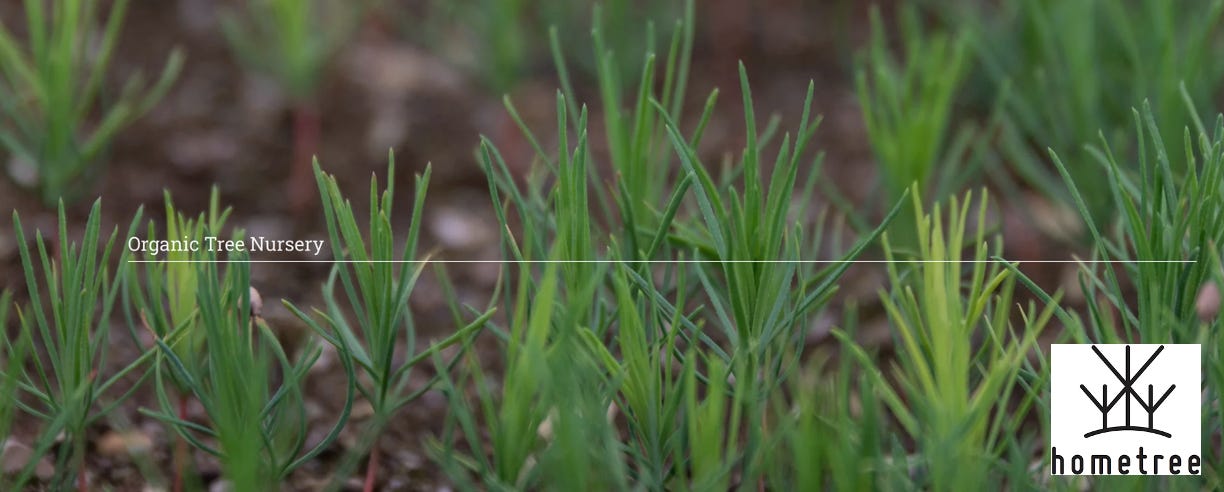
Standing among neat rows of baby Scots pine seedlings, I felt something tender and unexpected wash over me.
I was visiting Hometree’s headquarters in Ireland last week to accept my new role on their board of trustees, just a stone’s throw from the breath-taking Cliffs of Moher in County Clare.
These tiny, bright green fluffy baby trees, lined up neatly in their organic soil, gripped me with something I hadn’t expected—pure hope.
A living promise of what’s to come.
It was the kind of feeling you get when you first see a puppy: a rush of tenderness, joy, and awe. I was unexpectedly overtaken by emotion.
It wasn’t the fragile hope of wishful thinking, but the sturdy hope that comes from witnessing humans actually solving problems together and taking accountability for their impact well into the future.
Each baby tree precious, a promise. Each one part of stewarding the restoration of natural ecosystems destroyed by generations past, in ways that mimic their wild ecosystems, allowing them to thrive sustainably.
In this moment of awe and hope it felt like everything was possible.
The next day, that hope shattered in an instant.
When Hope Meets Reality
Back at the hotel in Ennistymon, sitting in a lovely sauna overlooking the river through a floor to ceiling glass window, I noticed something that made my heart sink.
The water had a marbled appearance. White streaks and patches floating on the surface like oil, creating patterns that looked almost artistic if they weren’t so alarming. The entire river had become a dangerously toxic art piece, and I could not keep my eyes off it.

No human in their right mind would dare entering those waters. The locals explained that people regularly get sick from this pollution, and that depending on the currents, they are used to the sea becoming contaminated as the toxins flow downstream.
I was flabbergasted, caught in the sauna’s heavy, hazy stupor.
I asked the locals for the cause of such a striking sight?
The cause, they told me, was farmers operating under “grandfathered” exemptions in Ireland’s nitrates derogation—meaning they can continue intensive farming practices with higher chemical applications that would be illegal for any new operation today.
Despite decades of environmental awareness, this level of active poisoning is still not only allowed but protected by law.
I could not believe my ears nor my eyes.
This stark contrast haunted me for days: the rows of hopeful baby trees at Hometree, thriving under careful stewardship just miles away from a river being actively poisoned.
We need to do better than this—collectively!
When rivers run toxic and endanger people and ecosystems, responses we all fall into, like “it’s not my responsibility” aren’t just inadequate—they’re a collusion with systems that endanger communities and shirk responsibility.
And, still, most people think there is nothing they can do. I dare say we are not facing an ecological problem, this is a human problem!
Hometree’s work is remarkable—they’re having tremendous impact already. They work with nature, and the work with humans and communities to achieve their goals.
But if the broader human problem isn’t addressed systemically, their and other NGO’s efforts become like bailing water out of a sinking ship while others keep drilling new holes.
It’s a lost battle, no matter how hard they work.
Why Most Environmental Efforts Miss the Mark or Fail Entirely
We keep treating environmental protection as a nature problem when it’s fundamentally a human problem.
Most approaches focus on technology, policy, and regulation, imposing new rules without partnering with the people who live on and care for the land every day—the very people whose behaviour is crucial for meaningful change.
Local communities are often seen as obstacles to navigate rather than partners to collaborate with. In reality, they know the land intimately and love it, even when they don’t know how to protect it.
While many environmental NGOs operate in a human-centric way, the old systems and most organisations still fail to do so.
Leaders frequently cave to self-interested lobbying instead of having the difficult conversations necessary to reach solutions that serve everyone, including future generations.
Allowing destructive practices to continue isn’t a suitable compromise—it turns into ecocide, a crime. (You can read about ecocide law in my Substack Transcending Eco-anxiety: Maintaining Optimal Leadership in Turbulent Times)
And I am afraid that this is sort of behaviour is enabled by our inability to resolve conflicts and find collaborative pathways forward.
The result? Rivers like the one in Ennistymon continue flowing poisoned.
Even well-intentioned policies cannot restore the planet if the humans implementing them remain disconnected from each other and from sustainable solutions.
We cannot heal the planet with broken human systems.
The Neuroscience of Disconnection
When people feel threatened, blamed, or dismissed, their nervous systems activate survival responses that shut down the prefrontal cortex—the brain region responsible for creative problem-solving, empathy, emotional regulation and long-term thinking.
This is exactly what happens when environmental policies are imposed from above without genuine partnership.
Farmers facing new restrictions experience this as an attack on their livelihood and way of life. They don’t feel understood. They feel threatened.
Their brains literally cannot access the innovative thinking needed to find win-win solutions. Instead, they fight, flee, or find ways to circumvent the rules—like the grandfathered exemptions that keep rivers running white with chemicals.
All human beings become self-centred and self-protective when they feel threatened. It’s not the farmers.
But when people feel genuinely heard, respected, and included in analysing problems and creating solutions, something quite different happens.
Their nervous systems regulate. The social engagement circuits come online. Suddenly, the same person who was defensive and resistant becomes capable of remarkable collaboration and creativity.
Research shows that when people feel psychologically safe, their stress hormones decrease and their capacity for innovation skyrockets. When teams learn to navigate conflict without losing connection, they become exponentially more effective at solving complex problems. The sense of shared purpose fuels them.
How NGOs like Hometree Change the Game

Hometree is extraordinary not just for their environmental work. Yes, they are ambitious and are restoring Ireland’s native temperate rainforests. They are also pioneering, using organic, no-dig practices that have already established over 30,000 native trees. Their Wild Atlantic Rainforest Project aims to restore 4,000 acres of forest, a vision that will outlive all of us.
And yet, what makes them so cutting-edge is how they approach this work.
They understand something most organisations miss:
Lasting change happens through partnership, not domination. Domination of the earth and each other is what got us to destroy ecosystems.
They work with farmers, not despite them. Instead of imposing solutions from above, they build relationships. They facilitate conversations, offer farmer advisory programs, peer-to-peer learning, and provide support that enhances rather than threatens livelihoods.
When farmers and communities feel like partners rather than problems, they become powerful allies for restoration.
They don’t compromise values—they innovate to uphold them.
Their ecological approach means they choose organic methods that are more costly upfront but result in stronger, more resilient trees. They grow native provenance seeds—varieties collected from local wild populations that are genetically adapted to Irish soil and climate conditions, supporting the wildlife that depends on these specific genetic lineages. Even when it is harder and less lucrative.
Rather than taking shortcuts with cheaper commercial seeds or chemical inputs, they invest in approaches that create forests capable of thriving for generations.
They prove you can be both principled and practical. Their practices promote nature and human health at once.
They recognise that restoration requires culture change as much as innovation and tech.
They understand that lasting environmental change requires people who feel connected to a shared purpose and to each other.
This is why they invited me to join their board of trustees. Not because I’m an environmental expert—I’m not. But because they understand that their mission will succeed or fail based on their ability to build the kind of culture where people can be honest, collaborative, and committed to outcomes that serve everyone.
They are keen to have the difficult conversations that lead to breakthrough solutions. They aim to help people stay connected to shared values even when they disagree on specifics- until they can find a better solution without compromising or giving up.
They understand that the quality of human relationships determines the sustainability of environmental solutions.
The Need for Sustainable Culture
Hometree sought me to help them build what I call a “sustainable culture.”
In my years working with purpose-driven leaders, I’ve seen how the same skills that transform difficult conversations can transform entire organisations—and ultimately, our approach to challenges like environmental restoration.
A sustainable culture is one where caring for people, communities, and the planet is built into how we live, work, and make decisions—so today’s actions don’t compromise tomorrow.
This means caring for the environment and the people in it. Supporting everyone’s wellbeing and voice—not just on paper, but in every interaction, every decision.
Supporting livelihoods by means that protect, not destroy.
It means making decisions based on what will still be working in 20 years, not just what looks good in the next quarterly report.
It means imagining what it’s like and will be like for other humans and life forms. This is true empathy, the capacity to imagine another’s point of view and experience, and to let yourself be moved by it.
It means learning to trust and choosing collaborative problem-solving.
In sustainable culture, difficult conversations become opportunities for deeper understanding rather than battles to be won or avoided. People feel safe to bring their full creativity and concerns to the table.
People face challenges with shared purpose. Innovation flourishes because people can take risks without fear of shame or retaliation. Change happens more organically because people feel connected to something larger than themselves and embrace the work it takes.
This kind of culture isn’t just theory. I see leaders developing the skills it takes to build it in every cohort of The Empathic Leader course. We practice in community, we develop a new way of relating that can uphold a sustainable culture. I am now taking the last registrations for the next cohort starting Friday Oct. 3rd. Information on my website if this transformation appeals to you.
The Ripple Effects of Human Connection
When leaders cultivate sustainable culture, the results are often unexpected—and transformative.
People who felt stressed and defensive suddenly become collaborative and creative. Farmers who resisted environmental policies start proposing innovative solutions. Communities that were divided by competing interests discover shared values and creative pathways forward.
I’ve seen this transformation countless times in my work. A tech executive who learnt empathic listening skills found his team’s innovation increased dramatically. A social impact founder who developed the capacity for difficult conversations discovered her organisation’s effectiveness multiplied. A sustainability leader who learnt to navigate conflict with connection found her stakeholder relationships transformed from adversarial to collaborative.
The solutions are simple, but the benefits are tangible: teams that function with genuine care for all involved—no backstabbing, no surprising, no hiding behind nice words. Honest communication that builds trust instead of eroding it. Meetings that actually engage people’s creativity rather than going through motions.
But this requires leaders who can turn every conversation—even the difficult ones—into moments that build an empathic, authentic, sustainable culture rather than tear it down. The kind of leaders people actually want to follow.
From Personal Healing to Global Impact
What I’ve seen again and again working with leaders for years is this:
To create lasting change outside, leaders must first develop the ability to stay calm and connected under pressure.
Happy, connected humans make different choices than stressed, defensive or isolated ones. And one of the biggest stresses on humans is broken relationships and disconnection.
And leaders have a special part to play here. The more power you have, the more influence your calm, connected presence can be.
We need tackle the human relationship problem if we want success in the other fronts.
We need to enable communities listen to each other deeply—without judgment, without rushing to fix. These communities are more resilient, and are more likely to find creative solutions that serve everyone.
When people are involved in creating solutions and they feel truly considered, buy-in and championing follow.
Leaders who can remain present and caring even during difficult conversations can facilitate the breakthrough discussions that prevent destructive conflicts or polarisation.
Having those conversations is never easy.
I love Emily’s story, a client working in marine conservation, who began The Empathic Leader course dreading the tough conversations, as most people. What made her unique is that she was aware that she needed tools to inspire the collaboration that actually enables the preservation of ecosystems she aims to protect.
Through developing her empathic listening skills, she discovered what I see often, but sadly is so rare: “The quality of all my relationships has massively improved” … and with that, her stress levels dropped significantly.
“At the end of the day, real change comes from deep, meaningful conversations.”
This is exactly the leadership skill set our world needs right now. Not just in environmental work, but in every arena where humans need to collaborate for positive change.
The ability to listen openly and to speak in ways that unite and clarify positive ways forward that work for everyone and for the planet at once.
Whether you’re leading sustainability initiatives, building social impact organisations, or trying to create positive change in your workplace or community, the foundation is the same:
Your capacity to remain present and connected under pressure determines the magnitude and sustainability of your impact.
If you want to develop this in community with other purpose-driven leaders, do consider The Empathic Leader course and schedule a chat with me to discuss your specific circumstances and difficulties.
The Path Forward
I truly believe that environmental restoration—like all collaborative impact—starts with our willingness to do our own inner work. To develop the capacity for difficult conversations without creating enemies. To be direct without being harsh. To maintain honesty while building connection.
I often say that these aren’t soft skills. Developing these skills is the hardest and most essential work of leadership. It’s what allows us to partner with people rather than forcing or manipulating them. It’s what creates the psychological safety necessary for true innovation. It’s what makes sustainable change not just possible but inevitable.
The baby trees at Hometree will grow into magnificent forests because the people caring for them understand that true success comes from mutual respect and genuine connection.
This is the leadership our world needs.
This is the culture that can heal both our organisations and our planet.
Let’s do it!
What collaborative impact are you being called toward?
About me
Thanks for reading! I’m Nati Beltrán, and I work with leaders who want to create positive change but struggle with the human side of leadership—the difficult conversations, the team dynamics, the pressure to perform while staying true to their values. When I’m not coaching or offering trainings, I’m probably walking in nature or reading about the latest research on how our brains work under stress.
If this piece resonated with you, please share it with someone who might benefit. And if you’re not already subscribed, I’d love to have you join this community of leaders committed to creating positive change.